
NJU ICS 程序的链接和加载 Note
Section 5 程序的链接和加载执行
本文结合了 CMU CSAPP 课程和 NJU ICS 的内容
由于 CSAPP 英文讲授且英文打起来更方便, 多数用英文书写。
ELF
Executable and Linkable Format
关于 ELF 表可以阅读 PA 2 的部分。
链接的本质
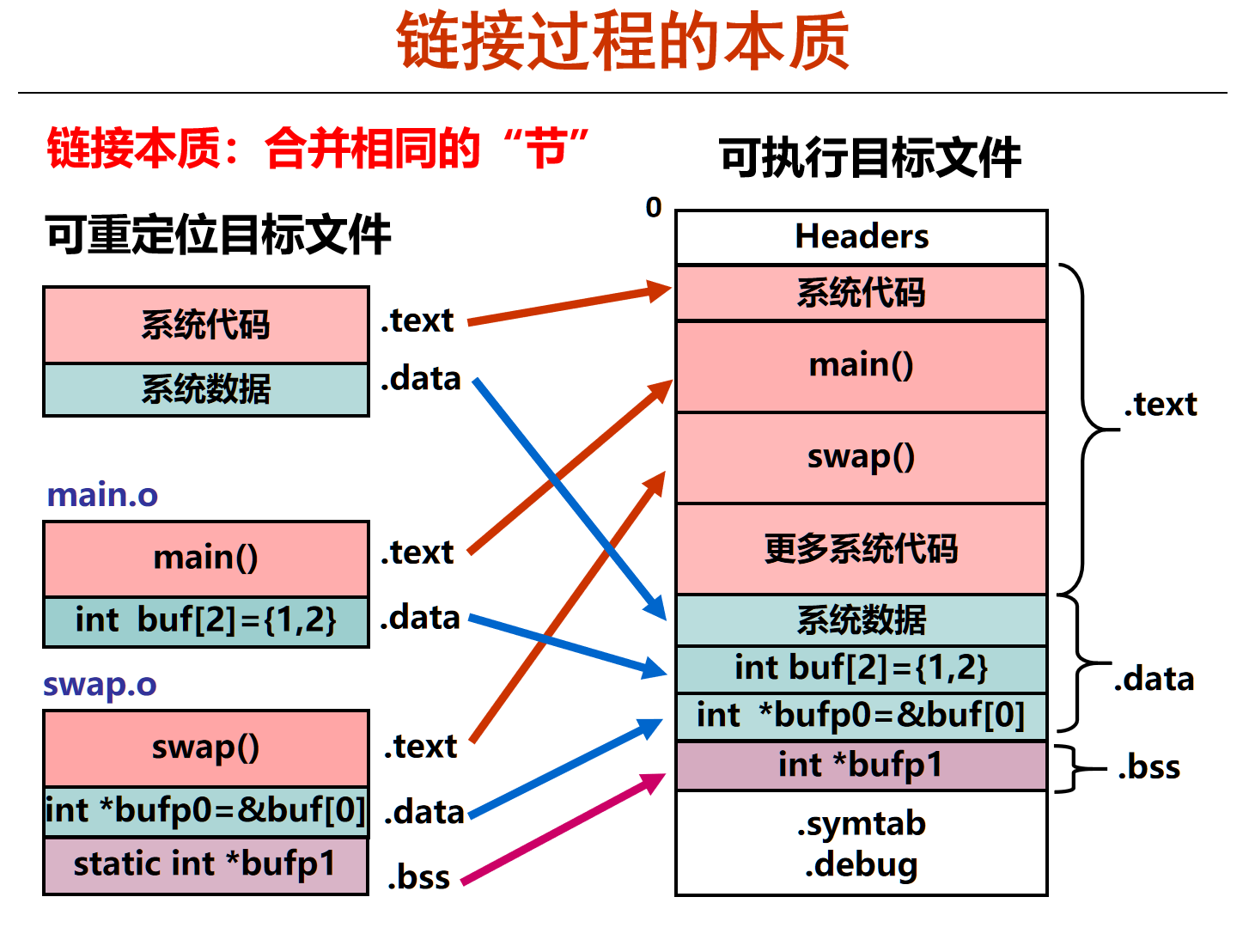
合并不同的 Section,形成一个大的表。
可执行文件的内存映像
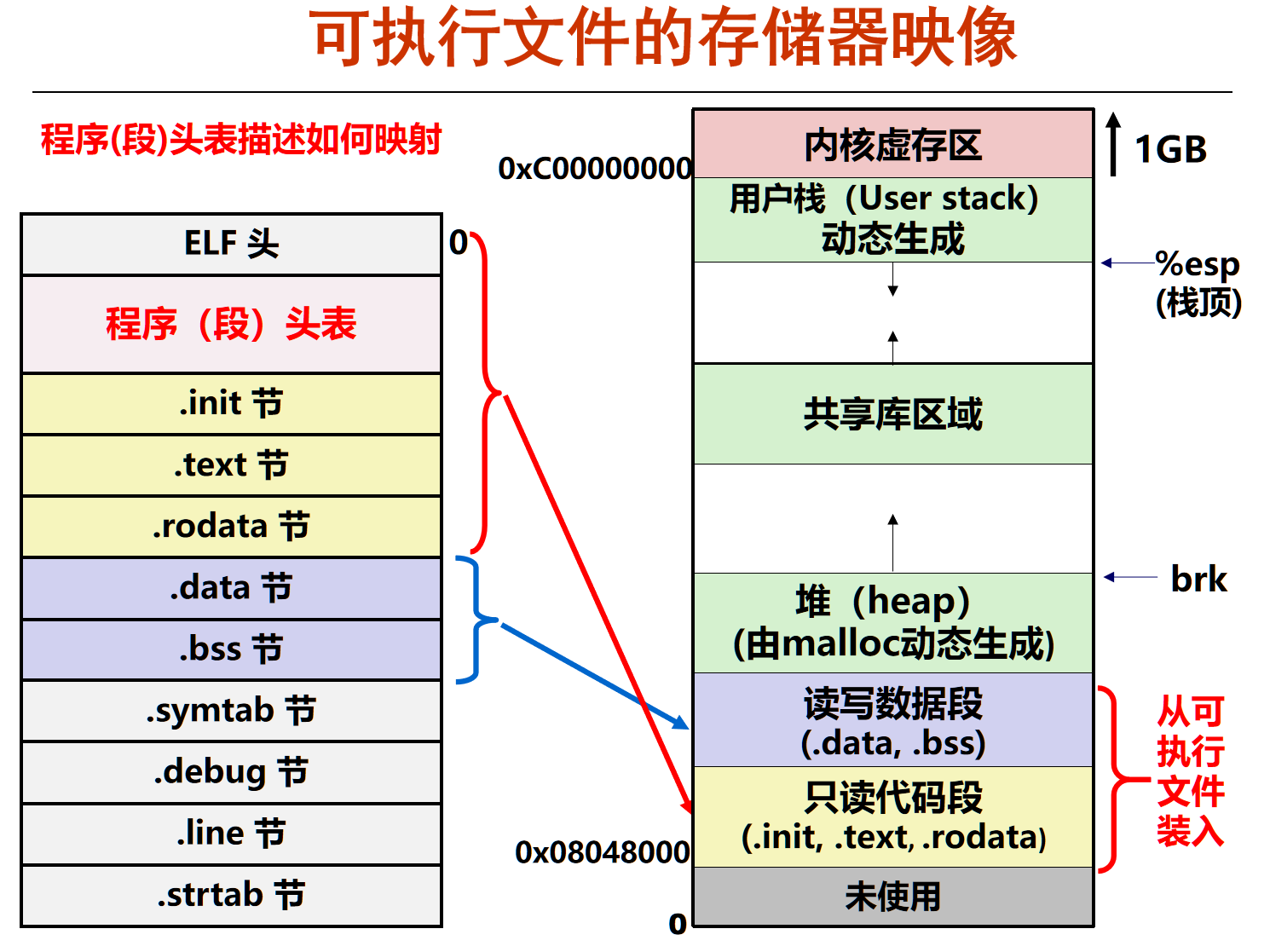
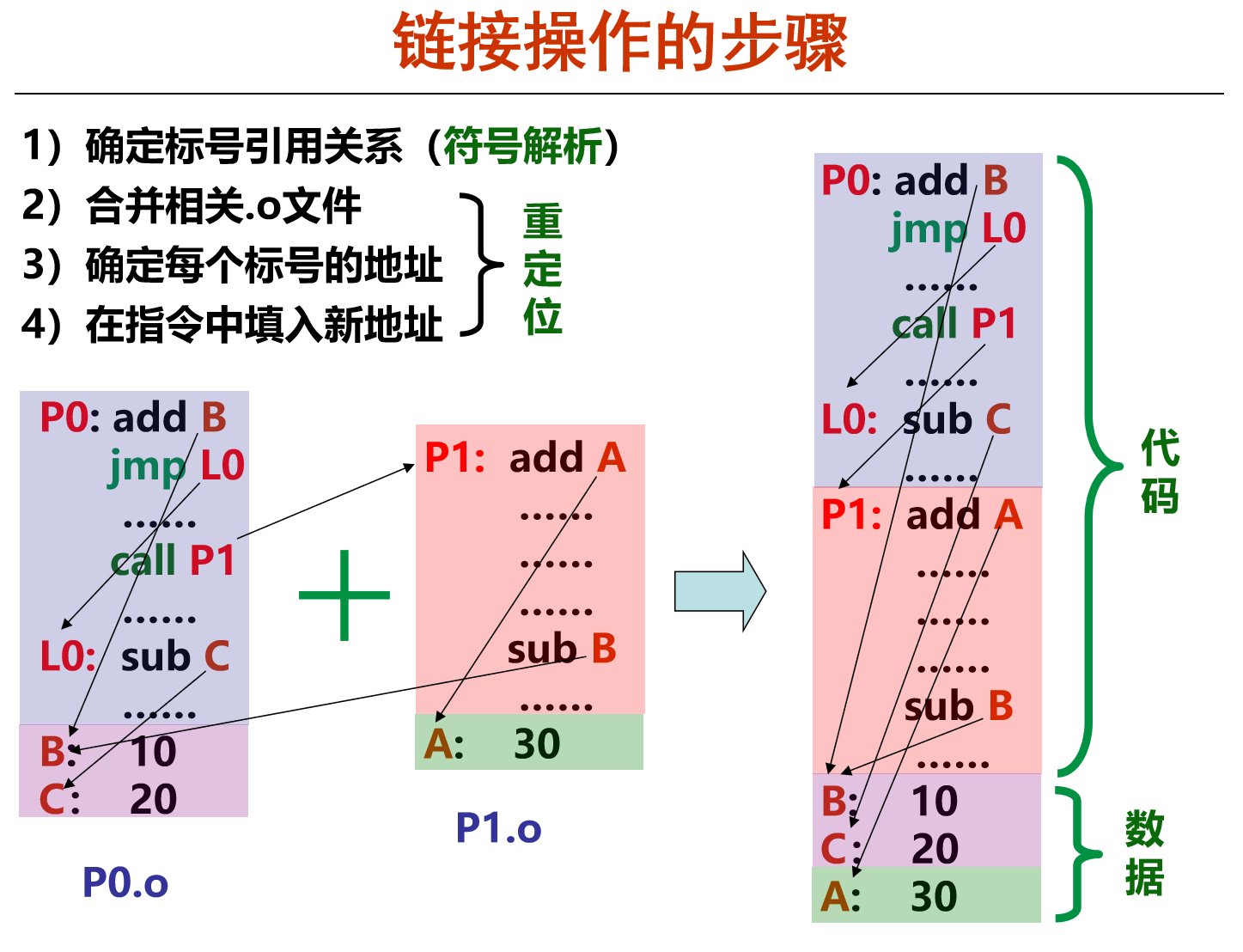
符号和符号解析
每一个 可重定位目标模块m 都有一个符号表,定义了在 m 中定义的符号。有三种链接器符号。
- Global symbols(全局符号)
- 由模块
m定义并能被其他模块引用的模块。 - 非 Static 的函数名和非 static 的全局变量名。
- 由模块
- External symbols(外部符号)
- 由其他模块定义并被模块 m 引用的全局符号
- 如
main.c,函数名swap
- 如
- 由其他模块定义并被模块 m 引用的全局符号
- Local symbols(本地符号)
- 由模块
m定义和引用的带static的函数名和变量名。因其生存期为整个程序运行过程,故并不分配在栈中,而是分配在static data区(静态数据区),即在.data或.bss节中分配空间。- 如
swap.c中的static变量名bufp1 .data中的有初值,.bss一般默认为 0
- 如
- 由模块
目标文件 ELF 中的符号表
可以参考阅读[[ICS-PA2 note#阅读符号表,对照字符表|如何阅读符号表]]
What Do Linkers Do
Step 1: Symbol resolution
- Programs define and reference symbols (global variables and functions)
void swap(){...}/* define symbol swap */swap();/* reference symbol swap */int *xp = &x;/* define symbol xp, reference x */
- Symbol definitions are stored in object file (by assembler) in symbol table
- Symbol table is an array of
struct - Each entry includes name, size, and location of symbol.
- Symbol table is an array of
Step 2: Relocation (重定位)
- Merges separate code and data sections into single sections
- Relocates symbols from their relative locations in the
.ofiles to their final absolute memory locations in the executable - Update all references to these symbols to reflect their new positions
Three Kinds of Object Files (Modules)
- Relocatable object file (
.ofile )- Contains code and data in a form that can be combined with other relocatable object files to form executable object file
- each
.ofile is produced from exactly one source (.c) file
- Executable object file (
a.outfile)- Contains code and data in a from that can be copied directly into memory and then executed
- Share object file (
.sofile)- Special type of relocatable object file that can be loaded into memory and linked dynamically, at either load time or run-time
- Called Dynamic Link Libraries by Windows
Executable and Linkable Format (ELF)
-
Standard binary format for object files
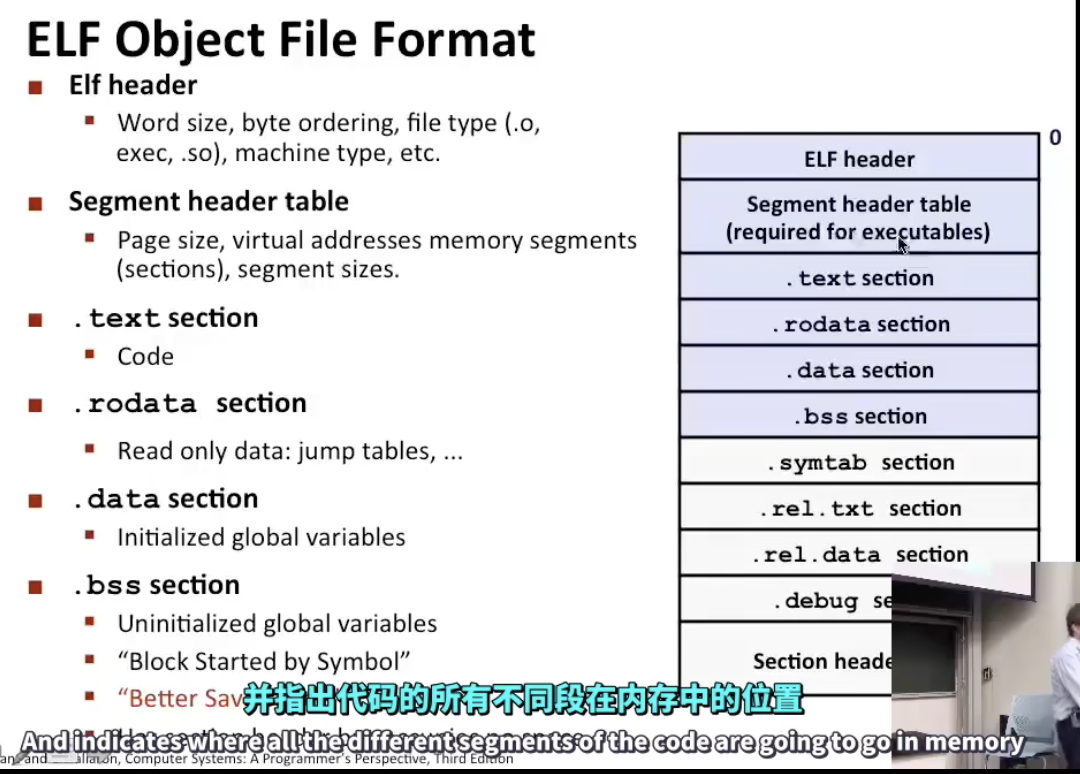
-
Elf header
- Word size, byte ordering, file type, machine type, etc.
-
Segment header table
- Page size, virtual addresses memory segments (sections), segment sizes
-
.textsection- Code
- function store in here too.
-
.rodatasection- Read only data: jump tables (in
switch), - some const number
- Read only data: jump tables (in
-
.datasection- Initialized global variables
-
.bsssection- Uninitialized global variables or static variables
- back to 60 s. IBM: block started by symbol
- “Better Save Space” (BSS)
- because uninitialized global variables no need to be in
.o, it save occupied space. .bss的核心逻辑是:“只记录需求,不存储实体”。- 在磁盘(可执行文件)中:
.bss节几乎不占空间。可执行文件的头部(Section Header Table)仅记录.bss节的总大小。例如,如果你定义了static int arr[1000000] = {0};,磁盘文件不会增加 4 MB,而只是在文件头里记下一行“我需要 4 MB 的零”。 - 在内存中: 当程序加载(Loading)时,加载器会根据文件头的记录,在内存中分配对应大小的物理页框,并统一将其清零。
- because uninitialized global variables no need to be in
-
.symtabsection- Symbol table
- Procedure and static variable names
- Section names and locations
-
.rel.textsection- Relocation info for
.textsection - Addresses of instructions that will need to be modified in the executable
- Relocation info for
-
.rel.datasection- Relocation info for
.datasection - Addresses of pointer data that will need to be modified in the merged executable
- Relocation info for
-
.debugsection- Info for symbolic debugging (
gcc -g) - provide Information that relates line numbers to in the source code to line numbers in the machine code.
- that why we can use
gdb
- Info for symbolic debugging (
-
Section header tableOffsetandSizeof each section
Linker Symbols
- Global symbols
- Symbols defined by module
mthat can be referenced by other modules. - non-static C functions and on-static global variables
- Symbols defined by module
- External symbols
- Global symbols that are referenced by module
mbut defined by some other module
- Global symbols that are referenced by module
- Local symbols
- Symbols that are defined and referenced exclusively by module
m - E.g.: C functions and global variables defined with the
staticattribute - Local linker symbols are not local program variables
- local program variable are in the user stack
- Symbols that are defined and referenced exclusively by module
Local Symbols
- Local non-static C variables vs. local static C variables
- local non-static C variables: stored on the stack
- local static C variables: store in either
.bssor.data
1 | // Compiler allocates space in .data for each definition of x |
How Linker Resolves Duplicate Symbol Definitions?
- Program symbols are either strong or weak
- Strong: procedures and initialized globals
- Weak: uninitialized globals
- 新标准:
- Common: unallocated uninitialized globals
- Linker will tell how to link this common symbol later.
- Weak*: GCC 拓展的属性指示符
__attribute__(week)- 这个
weak会被更强的所链接。
- 这个
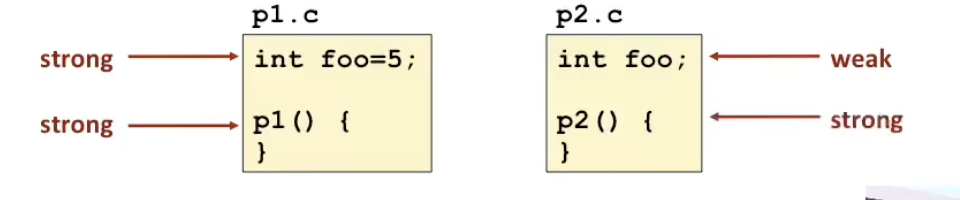
- Linker’s Symbol Rules
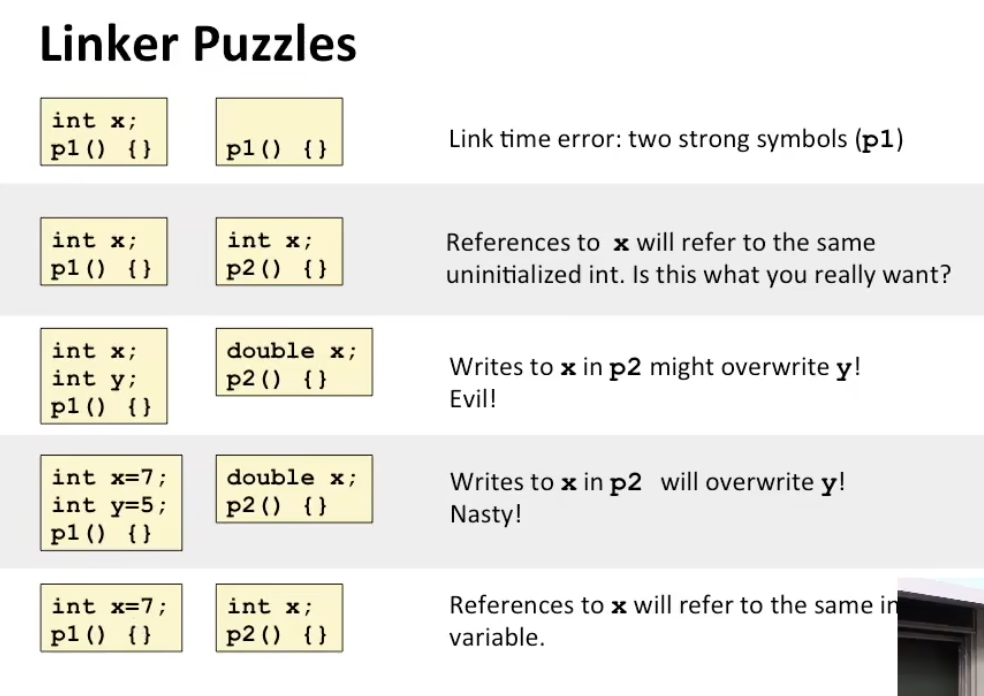
- Rule 1 Multiple strong symbols are not allowed.
- Each item can be defined only once
- Otherwise: linker’s error
- Rule 2: Given a strong symbol and multiple weak symbols, choose the strong symbol
- References to the weak symbol resolve to the strong symbol
- Rule 3: If there are multiple weak symbols, pick an arbitrary one
- Can override this with
gcc -fno-common- Or
-Werror
- Or
- Can override this with
- Rule 1 Multiple strong symbols are not allowed.
Relocated .text section
什么是重定位:
- 重定位的目的:在符号解析的基础上,将所有互相关联的目标模块合并,并确定运行时每个定义符号在虚拟地址空间中的地址 。在定义符号的引用处,重定位引用的地址。
临时地址到有效的绝对地址的修补。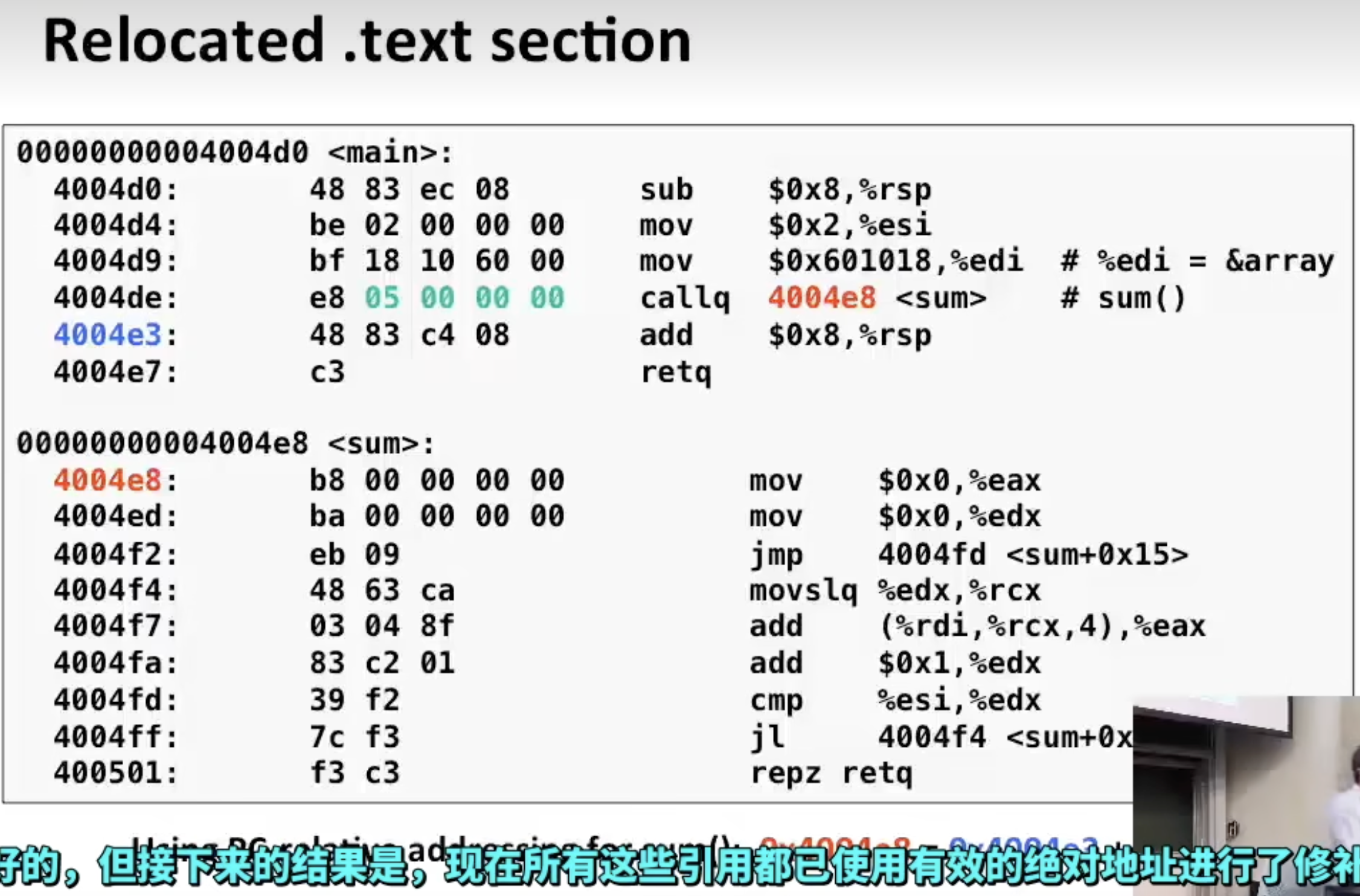
- 重定位类型
R_386_PC32:引用处采用 PC 相对寻址方式- 如上图的例子
R_386_32:引用处使用绝对地址方式
Using Static Libaries
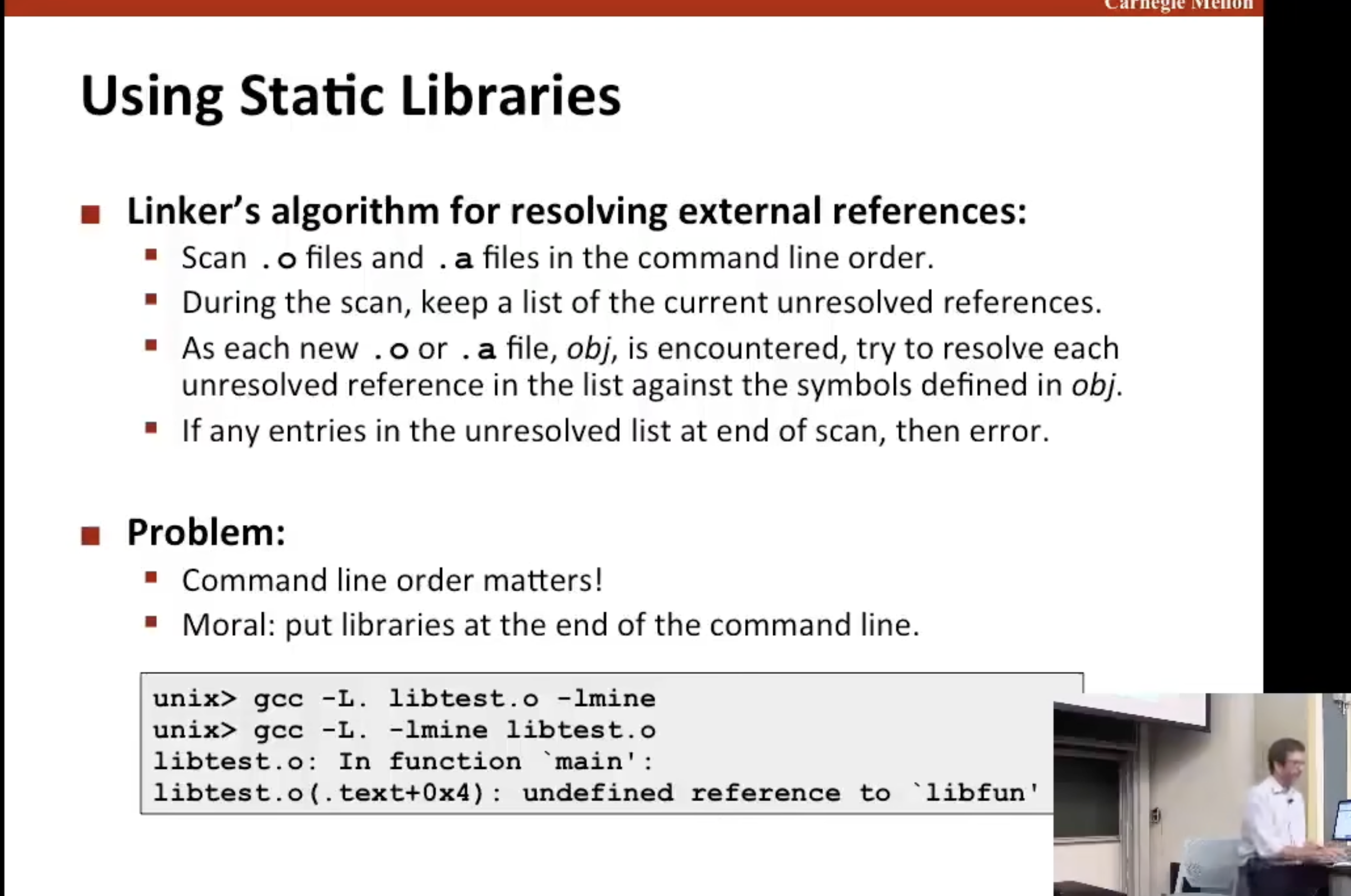
- Linker 对于外部引用 (external references)
- Scan
.ofiles and.afiles in the command line order - During scan, keep a list of the current unresolved references
- As each new
.oor.a(static libraries) , is encountered, try to resolve each unresolved reference in the list against the symbols defined inobj. - If any entries in the unresolved list at end of scan, then error
- Scan
- Command line order matters!
- affect how you scan
How to do risky link and compile?
To study link and compile, you may have to do risky link. However, gcc may prevent you from doing so by error your linkage. You can type following command to avoid it.
本博客所有文章除特别声明外,均采用 CC BY-NC-SA 4.0 许可协议。转载请注明来源 RedKold的小站!
相关推荐
2025-10-10
金融大数据处理技术(FBDP) lab1 日志
实验概况 本实验是南京大学计算机金融实验班 2023 级,金融大数据处理技术 (FBDP) 的 Hadoop 实验 1,主要是熟悉环境配置。 设备:Macbook Pro M4, ram: 24g docker + ubuntu 22.04 hadoop-3.4.2-aarch64 任务 1 环境准备 我们先用 docker 部署一个单机伪分布模式。 在终端 (我使用 iTerm2 -zsh) 输入 docker exec -it <container_id> /bin/bash 进入容器 sudo apt install 安装 vim 以修改设置 docker cp 命令将宿主机 Mac 下载好的 Hadoop 文件传输,解压,配置环境变量。 vi ~/.bashrc 123456789export HADOOP_HOME=/usr/local/hadoopexport HADOOP_INSTALL=$HADOOP_HOMEexport HADOOP_MAPRED_HOME=$HADOOP_HOMEexport HADOOP_COMMON_HOME=$...
2025-08-29
ICS-PA日记-PA0
这学期选了大名鼎鼎的 ICS,在刘杰老师班做 RISC-V 的 PA 实验。写一篇博客,来记录踩过的坑和心路历程。 PA 实验手册可参考:PA 实验手册 PA 0 主要是环境的安装和配置,我采取的方案是 MacOS 用 Windows App 连接阿里云服务器 (Ub untu 22.04) 做实验。本来以为在计算机网络课上完之后,对配置远程连接已经不在话下。但是还是遇到了一些问题。 在希望的道路上,曲曲折折的前进 运行环境搭建 1. 环境准备 云服务器:阿里云 Ubuntu 20.04 用户:kasumi(非 root,避免直接用 root 破坏环境) 之前的计网实验我都是用 root 账户做的,还沾沾自喜不用 sudo 真方便,现在看来是隐患极大的… 桌面环境:xfce 4 + xrdp 配置远程桌面 GUI,是为后面的 PA 需要一些图形化内容做准备。这个方案我的 Windows 和 Mac 都可以很方便访问阿里云的 Ubuntu,很方便我做实验和玩耍 目标:能跑 make menuconfig,配置并启动 PA 框架。 2. 安装和基本配...

2025-07-29
算法成长日记
前面的话 到大三了才深刻意识到自己算法基础的薄弱,趁暑期有时间应该多做一些算法题。 写一个 c++小算法还不如大一的自己了。所以在这里分享一些。 更新了分类栏目。 争取每工作日做一道题。 POPIAPA,PIPOPA, POPIPAPAPIPOPA! 其他小知识 树状数组 树状数组-利用 lowbit 的特殊数组数据结构,有奇效 前置知识 lowbit lowbit 即一个 $n$ 的数用二进制表示,其最低位的为 1 以及其后的 0 组成的数。 $44=(101100){(2)}$,$lowbit((101100{(2)}))=(100)_{(2)}=4$ 怎么得到呢? 将这个数取反,然后+1(这其实等价于取负),再和原来的数 与 就好了。 可以论证,$lowbit(x)=x&(-x)$ 通过树状数组结构可以快速得到一个数组某个位置前面的数 (作为一个数,它前面的数是它的子节点) 注意:$t[x]$ 保存以 $x$ 为根的子树中叶节点的值的和。$t[4]=t[2]+t[3]+a[4]=a[1]+a[2]+a[3]+a[4]$ 观察进一步发...

2025-11-06
ICS-PA日记-PA2
概况 本实验通过了所有 OJ 样例,实现了所有必做功能。 必答题备忘链接: 程序是个状态机-理解YEMU的执行过程 整理一条指令在 NEMU 中的执行过程 程序如何运行-理解打字小游戏如何运行 编译与链接 1 编译与链接 2 了解 Makefile 不停计算的机器 理解 YEMU 如何执行程序 理解 YEMU 如何执行程序 YEMU 可以看成是一个简化版的 NEMU, 它们的原理是相通的, 因此你需要理解 YEMU 是如何执行程序的. 具体地, 你需要 画出在 YEMU 上执行的加法程序的状态机 通过 RTFSC 理解 YEMU 如何执行一条指令 思考一下, 以上两者有什么联系? 画出在 YEMU 上执行的加法程序的状态机 在 YEMU 上执行的加法程序为: 12345678910uint8_t M[NMEM] = { // 内存, 其中包含一个计算z = x + y的程序 0b11100110, // load 6# | R[0] <- M[y] 0b00000100, // mov r1, r0 | R[1] <-...
2025-09-14
ICS PA1 report
前言 这是 ICS PA 要求提交的实验报告。一份更具有生活化气息的通关日记待我总结一下通关全流程,修一点 bug 再来更新~ 实验进度 我完成了 PA 1 的所有内容,通过了所有测试样例,并为了调试方便,加入了逻辑与或非等运算符。 一些问题和思考 为什么 printf() 的输出要换行 事实上我经常忘记加换行,但我发现这样就会出现 <some word you print balabala> (nemu) ,这会使得终端页面异常丑陋,同时输出可能堆叠在一堆里,不好看。 同时,printf() 写到标准输出 stdout 并不是立刻刷新,而 \n 起到一个刷新的作用,使用换行符能及时显示,避免程序异常退出导致缓存区 log 信息没有输出。 再探表达式解析 - 分治法和栈 我在大一的 程序设计基础实验 曾经完成过一个基于 Qt 的图形化计算器,可以计算包含括号的、有小数和负数的四则运算计算器。 事实上,当时我对于 - 的多义性(二目运算符 SUB? 单目运算符 NEG ?)的处理是采用了复杂的分类讨论。由于我用栈+后缀表达式实现算术式解析 (我曾经参考的文章) ,我...

2025-12-22
NJU ICS Section2 数据的机器级表示与处理 Note
Section 2 :数据的机器级表示与处理 ——数值数据的表示 关于高级语言->机器语言 表示 链接 执行 本章主要学习数据的机器级表示 Intro. Kahan 累加算法 浮点数存在误差 4000000 个 0.1(float) 相加(C 语言)结果可能不是 400,000 为了解决累加误差,有经典的 Kahan 累加算法 1234567891011function KahanSum(input) var sum = 0.0 var c = 0.0 //A running compensation for lost low-order bits. for i = 1 to input.length do y = input[i] - c //So far, so good: c is zero. t = sum + y //Alas, sum is big, y small, so low-order digits of y are lost. c = (...
评论